Question Tags in English: Complete Guide with Rules, Examples, and Practice
Question tags are an essential part of spoken English. They are widely used in conversations to confirm information, check agreement, or keep a discussion going.
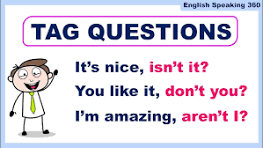
Question tags are an essential part of spoken English. They are widely used in conversations to confirm information, check agreement, or keep a discussion going.
Understanding how to use question tags correctly will make your English sound more natural, fluent, and confident.
What Are Question Tags?
A question tag is a short question added at the end of a statement.
It is used to:
- Confirm information
- Ask for agreement
- Encourage a response
Examples:
- You are tired, aren’t you?
- She can swim, can’t she?
- They didn’t come, did they?
Structure of Question Tags
The basic structure is:
Statement + comma + auxiliary verb + subject pronoun + ?
Examples:
- He is happy, isn’t he?
- You like coffee, don’t you?
Main Rule: Positive vs Negative
This is the most important rule:
- If the statement is positive, the tag is negative
- If the statement is negative, the tag is positive
Examples:
| Statement | Question Tag |
|---|---|
| She is here | isn’t she? |
| They are not ready | are they? |
| You like English | don’t you? |
| He doesn’t work | does he? |
Using Auxiliary Verbs
The auxiliary verb in the tag must match the tense of the sentence.
Examples:
-
Present simple:
- You work hard, don’t you?
-
Past simple:
- She went home, didn’t she?
-
Modal verbs:
- He can drive, can’t he?
Special Cases
1. “I am” → “aren’t I?”
- I am late, aren’t I?
2. Imperatives (commands)
- Open the door, will you?
- Don’t talk, will you?
3. “Let’s”
- Let’s go, shall we?
4. No auxiliary in the sentence
Use do / does / did
- You like music, don’t you?
- She finished, didn’t she?
Why Do We Use Question Tags?
Question tags are mainly used in speaking to:
1. Confirm Information
- You are a student, aren’t you?
2. Ask for Agreement
- This is interesting, isn’t it?
3. Keep Conversation Going
- Nice weather, isn’t it?
They make conversations more interactive and natural.
Intonation in Question Tags
The meaning changes depending on your tone of voice:
- Rising tone → real question
- Falling tone → expecting agreement
Example:
- You’re coming, aren’t you? (real question)
- You’re coming, aren’t you. (expecting agreement)
Common Mistakes
1. Wrong verb
- ❌ She is here, doesn’t she?
- ✅ She is here, isn’t she?
2. Same polarity
- ❌ He is happy, is he?
- ✅ He is happy, isn’t he?
3. Wrong pronoun
- ❌ John is here, isn’t John?
- ✅ John is here, isn’t he?
Practice Exercises
Complete the sentences:
- You are ready, ______?
- She can’t drive, ______?
- They went home, ______?
Answers:
- aren’t you?
- can she?
- didn’t they?
Conclusion
Question tags are a simple but powerful part of English grammar. They help make conversations more natural, interactive, and fluent.
To master them:
- Follow the positive/negative rule
- Match the auxiliary verb
- Practice regularly
Improve Your English Today
Do you want to speak English fluently and confidently?
Join The Brotherly Training Center and learn:
- English grammar (including question tags)
- Speaking and communication skills
- Practical English for real-life situations
Why choose BTC?
- Professional trainers
- Practical and interactive lessons
- Training adapted to beginners and advanced learners
Register Now
Start your English learning journey today.
- Visit The Brotherly Training Center at www.btcagapd.com or register here
- Contact us for more information at +243973111973
- Reserve your place in the next session
Share This Article
If you found this article helpful:
- Share it with your friends
- Help others learn English
- Spread knowledge in your community
Learning English is easier when we learn together and do not forget that teaching is touching souls forever
Partager l’article
Question Tags in English: Complete Guide with Rules, Examples, and Practice
Question tags are an essential part of spoken English. They are widely used in conversations to confirm information, check agreement, or keep a discussion going...